
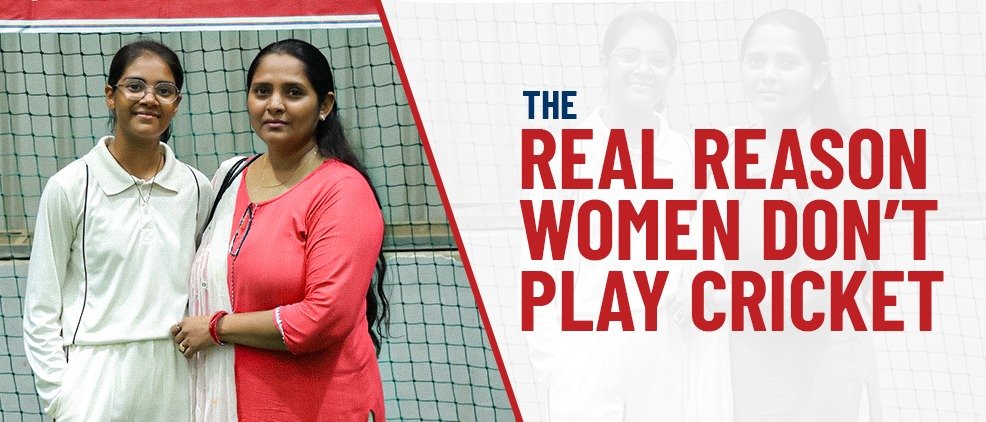
Cricket is more than a sport in India — it’s a national passion. Yet when we look deeper, a stark gender gap exists in participation, opportunity, and parental trust. While women’s cricket has made remarkable progress in recent years, significant barriers continue to prevent many girls from stepping onto the pitch in the first place.
1. The Participation Gap — What the Data Tells Us
A growing body of research shows that women in India are significantly underrepresented in sports overall — and this extends to grassroots cricket as well.
- National data indicates that only around 29% of women in India engage in any form of sport or physical activity, compared with 42% of men.
- Specifically in cricket, 15% of women participate compared to 25% of men, reflecting a major gender inequality.
- Globally, only about 3% of Indian women between ages 15 and 49 meet healthy activity levels, and 76% of adolescent girls do not engage in sports at all.
These figures highlight a persistent and meaningful disparity: many girls never get to the starting line across sports to a greater extent.
2. Fewer Opportunities at Every Step of the Journey
Part of the participation gap is structural — opportunities for girls to learn, train, compete, and be noticed are far fewer.
- Women’s cricket in India has a domestic structure and professional leagues, but the number of regular matches, scouting opportunities, and developmental programs are still limited compared to men’s cricket.
- Historically, the BCCI only took over women’s cricket in 2006, nearly 80 years after men’s cricket began at the international level in India.
- Research shows that lack of infrastructure, such as female-friendly facilities, dedicated coaching, safe training environments, and financial support, continues to hold girls back.
Without a robust and visible system of opportunities, aspiring female athletes often find themselves without a clear path to follow.
3. Trust and Social Barriers — The Hidden Constraint
Beyond opportunities, families and communities play a decisive role in whether a girl even tries a sport like cricket.
A range of socio-cultural barriers influences parental trust:
- Safety concerns — early morning/late evening practices, inadequate transport, mixed-gender environments.
- Lack of female coaches or female-only training groups.
- Societal expectations about gender roles and priorities (education, domestic responsibilities).
Studies on women in sports in India recognize that socio-cultural barriers remain a key reason for limited female participation. In many families, cricket isn’t seen as a “safe or suitable” pursuit for girls unless the environment is supportive and trusted.
4. Why This Matters — Beyond the Field
Participating in sports isn’t just about athletic achievement. Research connects sport with leadership, confidence, and life success. For example, community discussions on gender and development show that girls who play sport are more likely to build resilience, self-trust, and ambition — qualities that transfer into careers and personal life.
When girls are excluded from sport, India loses out on half of its potential talent and future leadership too.
5. What the World’s Champions Say
Globally, elite athletes have understood this truth:
“To keep believing in themselves… girls have been socialized — taught t
o be perfect, boys are taught to be brave. Don’t let yourself think that you have to be perfect.” — Billie Jean King on the cultural barriers girls face in sport.
King’s lifetime of advocacy reminds us that inequalities aren’t accidental — they are shaped by society and can be changed with intent.
Conclusion — A Call to Action for Cricket’s Future
Cricket has begun to change starting especially from state level cricket. The rise of professional women’s leagues, increasing media attention, and growing household support are positive trends. Also, things are bound to improve further especially after the Harmanpreet Kaur-led Indian Women’s team recently won the ICC Women’s ODI World Cup 2025 at home for the very first time. This massive milestone is a huge inspiration for young girls and even their parents that there is a definite future in this sport for both the genders.
But for India to harness its full talent pool, we must:
- Build more girls-centric grassroots programs.
- Strengthen trust-worthy systems — safe spaces, female coaches, and supportive environments.
- Create visible, aspirational pathways from school cricket to pro leagues.
- Educate families on the value of sport for girls’ confidence and life skills.
When opportunities and trust increase, participation will — and must — follow.
Disclaimer: The majority of information that is mentioned in this blog piece has been obtained from FitBiz, Sports Society, Reddit, IJARPS, the JGU Research Blog, Glamour UK, and Forbes, with the numbers being refreshed till December 2025.