
You must have heard of legendary cricketers like Sachin Tendulkar, Virat Kohli, Rohit Sharma, Rahul Dravid, and Zaheer Khan. Their journeys are celebrated, documented, and remembered. But names like Jalaj Saxena, Kumar Kushagra, Auqib Nabi, and Swapnil Asnodkar rarely enter mainstream conversations. Their stories often remain in the shadows. One major reason: many such players come from small towns and non-metro regions where visibility and access are limited.
Indian cricket celebrates its victories loudly but often forgets its near-misses in silence. Many of those “missed stories” are not failures of talent or determination — they are failures of opportunity. Across India, especially in smaller towns, players deliver outstanding performances at state and grassroots levels every season. Yet many never receive the platform or exposure needed to reach the highest professional stage. Their achievements become footnotes while others take centre stage.
Jalaj Saxena — The Cost of Being Unseen
Jalaj Saxena’s journey is a powerful reminder of this gap. A consistent and dependable domestic all-rounder for over a decade, Saxena delivered with both bat and ball across formats. He did everything the system asked — scored runs, took wickets, stayed fit, and performed year after year — yet never received an India cap. Sometimes, performance alone is not enough if the spotlight never turns your way at the right moment.
Born in Indore, Madhya Pradesh, Saxena made his first-class debut in 2005. He represented Madhya Pradesh, later Kerala, and then Maharashtra. His first-class record is remarkable: over 500 wickets in more than 150 matches at an excellent average, along with over 7,000 runs, including multiple centuries and half-centuries. These are elite numbers by any standard — yet international recognition never followed.
This is not an isolated case. Indian domestic cricket has seen many such players — consistent performers who carried teams but never crossed the final selection barrier.
As Aakash Chopra once observed:
“You can have the numbers, the fitness, and the skill, and still not get picked. That’s the reality of Indian domestic cricket.”
The Unequal Geography of Opportunity
India’s cricket ecosystem remains heavily skewed toward major centres. Metro cities offer structured academies, better coaching, advanced facilities, match footage, analytics, sponsorship exposure, and stronger networks. Selectors and scouts are more present. Matches are recorded, discussed, and circulated.
In contrast, small-town players often rely on limited infrastructure, fewer tournaments, and minimal visibility. A five-wicket haul on an untelevised ground or a match-winning hundred in a district tournament rarely travels beyond local boundaries. Performance without visibility becomes invisible performance.
The consequences are serious. One injury, one bad season, or one financial setback can end a promising career. Families struggling with resources cannot support long, uncertain journeys. Gradually, cricket shifts from dream to hobby — and then disappears entirely from a player’s life.
MS Dhoni’s words ring true here:
“You don’t play for the crowd. You play for the country.”
But without a pathway, many never get the chance to play for either.
Grassroots Leagues Are No Longer Optional — They Are Essential
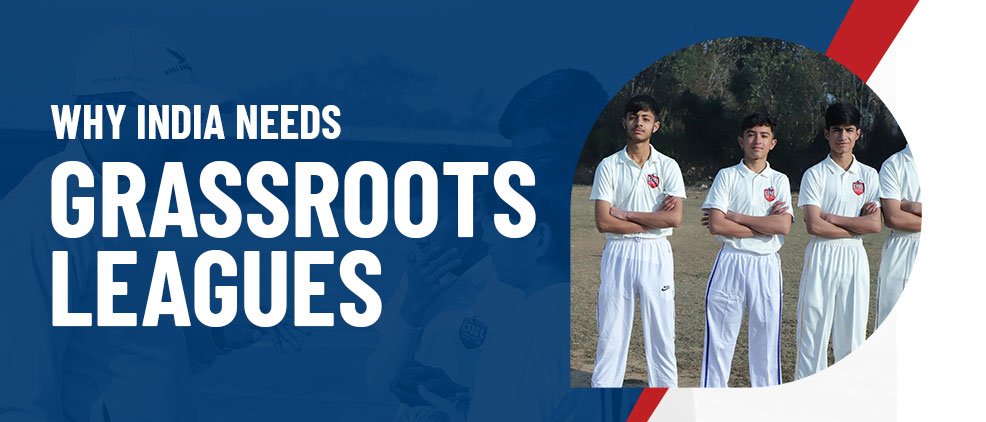
Grassroots leagues are not just alternatives anymore — they are necessities. They widen the talent funnel and multiply evaluation opportunities. Instead of depending on one standout performance, players are judged across multiple matches and situations.
Such leagues create structured competition, long-term tracking, mentorship access, and getting repeated exposure of featuring in the national cricket championship in India. They allow talent to be measured over time — not by chance, but by consistency.
They also bring selectors, coaches, and analysts closer to emerging players. That continuous observation is what converts raw potential into professional readiness.
C11CL – Building The Missing Layer
Champions 11 Cricket League (C11CL) was built on a simple but powerful belief: India’s cricketing future lives beyond elite academies and stadiums — it lives in local grounds, small towns, and overlooked pockets of talent.
C11CL is designed as a national grassroots platform focused on equal access and structured opportunity. Talent discovery is only the first step; sustained development and repeated assessment are what truly matter.
The league conducts open state-level cricket trials to remove geographic and background barriers. Selection is performance-based — not reference-based. Chosen players compete in organised tournaments that simulate professional environments, helping them build match temperament, discipline, and consistency.
Transparency is central to the system. Players understand where they stand, what is expected, and how they can improve. That clarity restores trust — something many aspiring cricketers lose over time.
What are the learnings from Jalaj Saxena’s story?
Jalaj Saxena’s journey teaches us that unequal opportunity carries a heavy cost — not just for players, but for the sport itself. When systems fail to provide exposure, continuity, and support, cricket loses proven performers.
C11CL aims to prevent such stories from repeating. Through recurring competitions, structured assessments, and mentorship, it ensures that strong performers remain visible and relevant — not forgotten between seasons.
As Sachin Tendulkar said:
“Chase your dreams, but don’t let anyone tell you they’re impossible,” said God of Cricket, Sachin Tendulkar.
Talent Is The Only Currency
C11CL does not promise instant fame or guaranteed national selection. What it offers is more meaningful — a credible, structured pathway. With growing networks of mentors, coaches, and cricket professionals, it focuses on long-term player development.
Great cricketers are not built overnight. They need time, competition, feedback, and resilience. C11CL aims to provide that runway.
Its vision is clear: to become India’s most trusted grassroots cricket league — one that creates professional pathways through fairness, access, and performance-based selection, free from financial or political bias.
Final Thoughts
Big dreams don’t die in small towns because of a lack of ambition — they die because opportunities arrive too late or not at all. Stories like Jalaj Saxena’s reveal what the sport loses when systems fail deserving players.
Grassroots leagues like Champions 11 Cricket League are not just filling a gap — they are redesigning the pathway. By bringing structure, fairness, and visibility to grassroots cricket, they help ensure that future stars are recognised — not overlooked.